

A buddy sent me a link the other day. An article about a guy in San Francisco named Riley Walz who builds absurd, delightful internet projects for no reason other than he thinks they’re funny. Fake steakhouses on Google Maps, etc. etc.
The article, written by his friend under the pseudonym Aadil Pickle on a site called Alexandria, includes a photo of Riley holding open a book to a page titled “Wouldn’t It Be Funny If.” Riley owns four copies of this book. Gave one to Aadil when Aadil complained about his own creative process. The book is called The Motern Method.
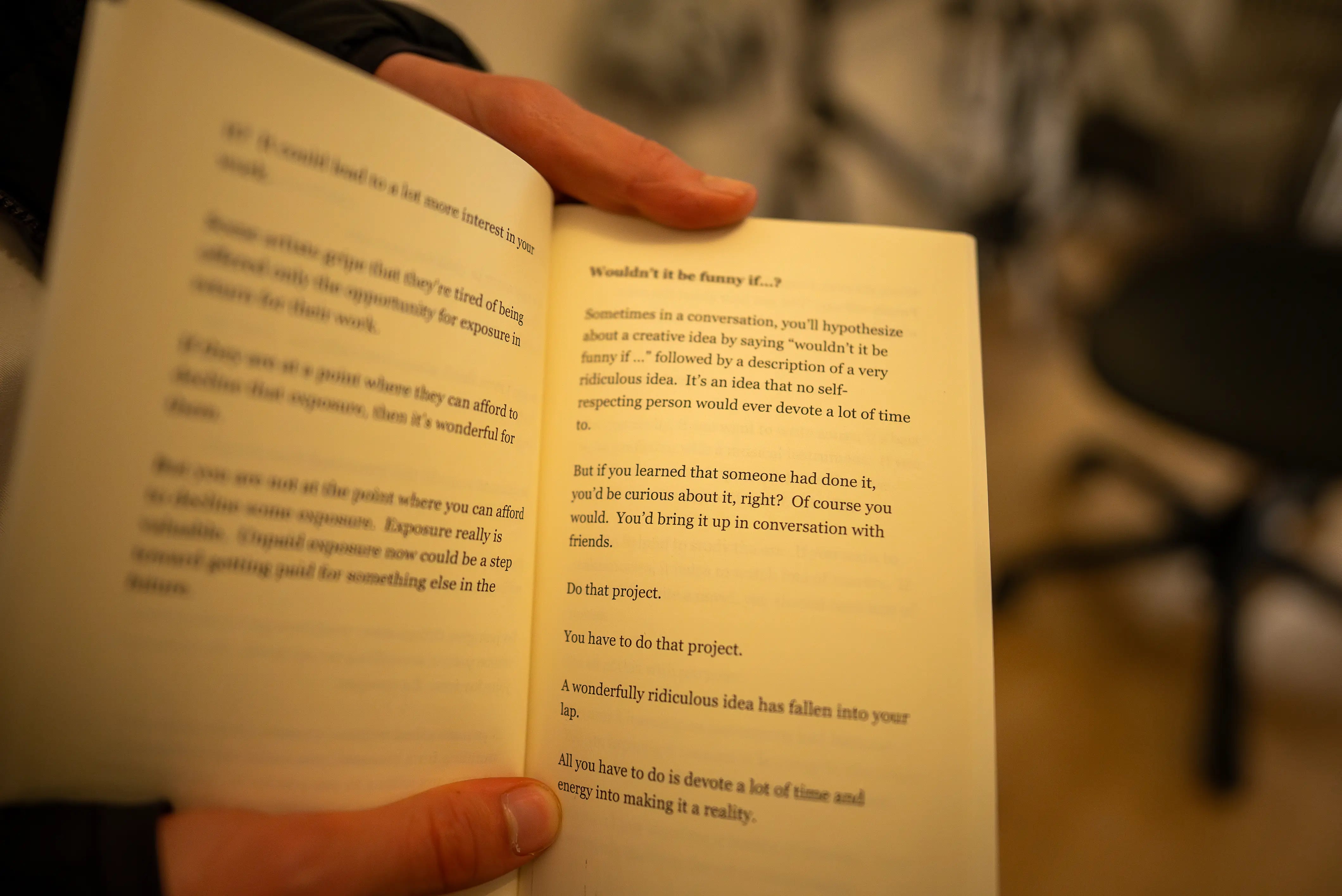
So of course I bought it.
It arrived, sat on my nightstand for a week, then I read it in one sitting.
Farley is an interesting cat. He's a songwriter (?) from Danvers, Massachusetts who has released over 26,000 songs. He's made over a dozen feature-length films. He writes books. Few of them hits by any traditional measure. Yet he makes roughly $200,000 a year doing this.
I can’t help but make the comparison, he’s the blue-collar Rick Rubin. Both books read like the Tao Te Ching, collections of aphorisms about the creative life delivered in their own voice. Farley self-published (of course) The Motern Method in three months, because why not?
The writing is simple. Short chapters, short sentences. Every phrase lands like a proverb you already knew but hadn’t yet said out loud. The kind that sting a bit because the reason you haven’t done the thing isn’t that you lacked information, it’s that you lacked nerve.
I wish more people would do this.
The discovery chain for this book is itself a demonstration of the method. A friend sends a link. That link leads to an interesting person. That person found another interesting person who wrote a book about his process. You read it in an evening. Organic discovery, all the way down.
An absolute blast. Funny, honest, and creative. Highly recommend.
Follow the rabbit hole
Vitals: The Motern Method by Matt Farley. Self-published, 2021. 136 pages.
The Rabbit Hole: Riley Walz (Alexandria) | Matt Farley (Archive)
Pairs Well With: Rick Rubin’s The Creative Act, Steven Pressfield’s The War of Art, Nassim Taleb’s Antifragile
Highlights
12 passages I dog-eared.
Tell Everyone
Tell everyone about the plan for project.
It’s more creative and interesting than small talk. And it’s a great motivator.
Because now you have to complete the project.
Otherwise, all those people will think you’re a failure.
This might not be true. In fact, those people probably don’t care whether or not you finish your project. But you care. You will feel like a failure each time you see them.
At your darkest moments, when you’re ready to quit, you can imagine all those people scoffing at you. Imagine them thinking you’re a failure.
Imagine them being disappointed in you.
Imagine them rolling their eyes next time you tell them about an idea.
Then get back to work.
Say Yes to your ideas
If you come up with an idea for a project, then you should treat that idea with the respect it deserves by following through on it.
Your idea might be simple. Your idea might be brilliant. It could be very serious. It could be very silly. It could be something that inspires you to work. It could be something that you don’t really want to do.
In all cases, you gotta do it. No matter what.
Why?
Because your brain will get mad if you don’t listen to its ideas. Your brain will think, “If my ideas aren’t being listened to, then I’ll stop coming up with ideas!”
That’s why you have to do it even if you think it’s a bad idea. Your brain won’t offer the next good idea until you’ve seen the bad idea to fruition.
Friends and Family
Friends and family will not react to your work in a way that makes you feel good.
Presenting your work to them is an excruciating experience.
You’ll watch needily as they take in what you’ve created. You’ll interpret their facial expressions, their breathing patterns, etc., looking for a sign that they like it or don’t like it. You’ll watch with exasperation as they get distracted and stop paying attention to what you’ve created. And then they’ll say something nice, which you will interpret for the next several weeks. Was there a subtle insult mixed in with that compliment? Did they mean it? They might compliment the el current work by mentioning that it’s better than your previous work. Of course, that’ll only make you defensive about your previous work. It can get really uncomfortable.
None of this is their fault.
It’s your fault.
They don’t know the proper way to react to art made by someone they know. Nobody does. It’s an inherently uncomfortable thing. They’re used to taking in art that is made by someone they would never dream of meeting. Or they simply never really think about how art is made. It’s just something they take in without much analysis.
Now you’re coming to them with a work of art, and a huge amount of desperation.
It’s awful for your friends or family to be put ine that situation.
You are like a child showing a drawing to a od parent.
Only that child is much better at accepting from insincere praise, then moving on to the next project.
Self Promotion Self promotion is ugly.
Self promotion is stinky.
That’s why world-famous artists hire other people to do it for them.
You are not a world-famous artist. You can’t afford to hire someone to tell the world about how great you are. You need to do it yourself.
Even if you could afford to pay someone else to do it, is it really right to do that? These hot-shot artists act cool and humble, all the while they are paying another person to promote them and their work. Is that cool? Is that humble?
Musicians have billboards with their names and faces on them. If you ask them, they say that the record company did it. But that musician didn’t have to sign with the record company. When they signed, they knew that the record company would use every ugly, stinky, shameless method to promote them. You don’t want to play that game.
You can do the dirty work yourself.
It’s much more honest.
So when you’re feeling reluctant to promote your work, just remember that all your favorite famous artists are doing way more to promote themselves, and with fewer scruples. They appear in commercials for credit cards. They write songs for insurance companies. They do private concerts for evil dictators.
You wouldn’t do any of those things.
But you can promote yourself. You can send out press releases about your work. You can run an advertisement for journalists, asking them to write articles about you.
your work. You can contact It doesn’t have to be all business. Your selfpromotion can incorporate your own personal 201 51 taste and style so that it feels a little less ugly, a little less stinky.
Ideally, you wouldn’t have to promote your work.
You could just release it, and then collect a fair wage from sales.
Until then, it’s ok to be scrappy and shameless.
Craft, Then Art
You usually need to practice your craft a long time before you can create art.
This is not always the case.
But, generally, if you want to write songs, it’s best to be proficient with a musical instrument. If you want to paint a masterpiece, it helps if you’ve learned how to work with paint. Etc. Etc.
It’s also helpful to study the art. If you want to make movies, it helps to watch lots of movies. If you want to write a novel, you should read lots of novels.
Do all of this with purpose.
You aren’t learning an instrument just because.
You are learning it because it is a step in the noble process of eventually creating something great.
You aren’t just watching a bunch of movies. You are actively studying the art of filmmaking.
Keep Your Day Job
It feels wrong that you need to work a day job.
After all, you are filled with creative energy.
There’s so much you could accomplish if your days were free.
But don’t quit your day job!
You don’t want to be a starving artist.
There’s no pride in only working on your art if your art isn’t earning you any money.
Sleeping on couches? That sounds so romantic.
But who paid for the couch? Someone who works a day job. And that person feels great resentment toward you if you use their couch for more than a couple nights. It’s not right. It’s not fair.
If you’re always looking for a place to sleep each e night, maybe that means you’re not really using all your time to work on your art.
Exercise
Arts and athletics don’t often get lumped into the same category.
But they should be!
Athletics of any kind are great for creativity.
Creativity is frequently a sit-down kind of activity. Sitting down all the time is not good for you in many ways. For the purposes of our book, sitting down is bad because it limits your opportunities for inspiration.
You can force the inspiration by sitting down and thinking really hard. Seriously. This can work.
And you should employ that method sometimes.
But another method is to let the inspiration come to you while you’re doing something else. Exercise is a very good way to make that happen.
Fund Your Own Projects
There’s something not quite right about asking people to pay for the creation of your project.
This goes for movie directors who are given tons of money by a studio to make a movie. This goes for musicians and writers who accept advances from corporations.
It also goes for you when you start a funding campaign to pay for the creation of your artwork.
There’s just something underhanded about it.
You want the joy of creation without the pain of paying for it.
It’s one thing if you get to the point where your fans are willfully donating to the cause because they appreciate your work and they want to help you make more. Are your funders doing it for that reason, or just because they feel bullied into donating? If most of the funding is coming from friends and family, then odds are they feel bullied. You’re like a niece or nephew who shows up with a bunch of cookies that your aunt and uncle feel obliged to purchase for a school fundraiser.
But you’re not a cute niece or nephew. You’re old enough to fund your own project.
How devoted to this project are you?
If you’re truly devoted, then you need to be the one who works hard to make it happen. That means making sacrifices. That means aggressively saving money. It should hurt.
If you’re asking someone else to pay for it, then it just feels like you don’t really care that much.
There’s a certain laziness to that approach which will trickle down through the entire project. If it’s someone else’s money on the line, then you won’t be as committed to the project as you would if it were your money.
Vicariously Tap Into Universal Feelings
Feeling uninspired?
Engage with someone else’s art until something about it inspires you.
As soon as that inspiration comes, get to work on your own art.
For example, you could watch a sad movie. If it fills you with emotions, immediately start writing a song that expresses those emotions. You can even write the song from the point of view of a character in the movie.
bit. But No matter how interesting your life is, you might run out of direct experience to write about. That’s when you use your imagination to insert yourself into other works of art, and create something out of that.
The most important thing to remember is that you’re not just being entertained. You’re actively engaging with a work of art. You’re taking notes.
This isn’t cheating. Works of art have always inspired other works of art. Continue the tradition.
It doesn’t Need to End Up Like You Thought It Would
You wanted to make something funny, but it turned out sad.
You wanted to make something inspiring, but it turned out comical.
You wanted to make something funny, but it i turned out scary.
That doesn’t mean it’s bad.
Your audience will come to it with no expectations. They’ll enjoy it (or not) for what it is, not for what you intended it to be.
Projects can evolve over the course of their creation. You can fight it if you want. But it’s probably easier to just follow the direction that the project is naturally going in. Go with it. Be surprised by your own creation as it reveals itself to you.
**Note:** The importance of embracing emergence
Self Promotion vs. Organic Discovery
Self promotion works. It’s worth the effort.
Organic discovery works much better. It’s much less effort.
Self promotion means you are trying to convince someone to explore your work.
Organic discovery means someone just finds your work on their own.
played along for If you tell someone they need to check out your work, it suddenly becomes a chore to them. If they just find it on their own, it becomes a treasure that they went searching for. They’re proud to have discovered it, and therefore more likely to enjoy it.
ing unconventionally to be So what does that mean for you? Should you not bother with promotion?
No. You should still promote your work. It really works sometimes.
But you can also view your output as a self promotion tool. If you create a lot of stuff, then that means there’s more stuff out there for people to discover. Once they’ve discovered it, they might be tempted to explore more of your work.
And since you created a lot of stuff, there’s a lot of your work for them to discover.