

The Burger Test
You’re at a table with a friend. He says I want a quality cheeseburger. You say I got you.
You could serve him two wildly different things and be correct about your interpretation of quality both times.
Burger one. Wagyu beef, freshly ground to order. House brioche bun. Aged cheddar that costs more per ounce than the beef. Secret sauce whisked by a chef with Michelin stars on the wall. Grilled over binchotan, the good charcoal, the Japanese stuff. This burger costs forty dollars and it earns every penny. Everything is considered. This is a quality cheeseburger.
Burger two. Double-Double animal style. Three bucks and change. Made in ninety seconds by a flush faced-kid in a paper hat following a system so precise that the burger you get in San Diego is the same burger you get in Tucson is the same burger you get at the one near LAX at midnight. This is also a quality cheeseburger.
Both are quality. They are not the same thing. They are not achieving remotely comparable outcomes. And yet the word “quality” applies to both of them without hesitation.
That gap, the space between two completely valid uses of the same word, is where most conversations about quality fall apart. We don’t have a quality problem. We have a quality literacy problem. Nobody talks about this.
You Know It When You See It
We use “quality” the way Justice Potter Stewart used “obscenity.” You know it when you see it.

He wasn’t wrong. We do know it when we see it. I believe sensing quality is one of the most powerful intuitions humans have. You walk into a room and you feel it. You pick up a tool and you know by the heft in your hand. You take a bite and it’s either there or it isn’t.
Pirsig wrote an entire novel chasing quality in 1974. Zen and the Art of Motorcycle Maintenance is great precisely because the question he tackles is so slippery. What is quality? Where does it live? Is it in the object or the observer?
But here’s where I think Pirsig left an opening. The reason quality is so hard to define isn’t because it’s mysterious (it is, a little, but that’s not the main issue). It’s because quality isn’t one thing. It’s one word doing far too much lifting. And until you learn to calibrate on the meaning, you will continually run into mismatched perceptions, conversations that feel like agreement but aren’t, decisions that feel right but ultimately miss the mark. We default to “I know it when I see it” as if that’s good enough.
It’s not.
The Vector Matrix
Here’s my take. Quality has spatial orientation. It moves around a vector matrix. And the coordinates are determined by constraints.
There are at least four dimensions that set coordinates: cost, time, skill, and scale. Every quality evaluation lives somewhere in the space these create. Change the constraints, you change what quality means.
The wagyu burger is high cost, high time, high skill, low scale. The constraint set is essentially wide open, full throttle. Quality on this vector means pushing every variable to its highest expression. Best beef. Best bun. Best cheese. Best fire. The sky is the limit.
The Double-Double is low cost, low time, moderate skill, extreme scale. The constraint set is borderline oppressive. And quality on this vector means something completely different. It means a system so refined, so intentional, so lean that the output is remarkable because of the constraints. Not despite them. This is where consumer surplus lives.
This is not just a food thing. The sonnet is constraint optimization. Fourteen lines, iambic pentameter, specific rhyme scheme, and within that box Shakespeare communicated more about love and death than most writers manage with unlimited pages. Haiku. A three chord punk song. A Leica M.
Craft maximization is a different game entirely. A cathedral fresco. A Patek Philippe. Jiro’s Omakase. A Christopher Alexander building where every room feels like it couldn’t have been anything else. This is quality too. Obviously. But the coordinates are different. The constraints are different. The evaluation criteria are different.
Neither aim is necessarily superior. They are simply optimized under differing constraints.
The Game
Enter James P. Carse. Finite and Infinite Games, 1986. One of the books that permanently reoriented my perspective.
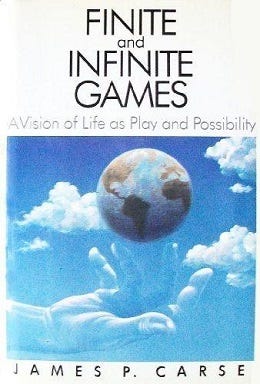
A finite game is played to win. An infinite game is played to keep playing.
The brands and the systems that sustain quality over decades are all playing infinite games. In-N-Out has been playing the same infinite game for seventy-five years. Same menu. Same quality. Same constraints, honored religiously (literally). They’re not trying to beat Five Guys. They’re not optimizing for quarterly earnings. They’re playing a game that doesn’t have a finish line.
You know when quality dies? When someone switches the game. When a private equity firm buys a brand that was playing an infinite game and converts it to a finite one. Hit the margin. Cut the cost. Juice the top line. That’s what happened to J.Crew. To Brooks Brothers. To Quiksilver and Billabong, two of the most iconic surf brands ever built, both bankrupted, merged, sold to a brand holding company, and as of last year, liquidating their remaining stores. The constraint set didn’t change. The game changed. And quality collapsed along with the viability of the business.
I want to be very clear about something because this distinction matters a lot. Cost cutting by degrading quality is not constraint optimization. They look similar from the outside. They could not be more different. Constraint optimization is intentionally choosing a vector and producing the best possible output within those constraints. Cost cutting is removing the constraints that were producing the quality in order to extract short-term margin. One is an infinite game. The other is a finite game.
Calibration
So here’s the move. Before you can evaluate a product, a company, a meal, a decision, a life… you calibrate.
What vector are we on? What are we optimizing for? What are the constraints? Cost, time, skill, scale… where are we? What game is being played, finite or infinite?
Skip this step and you end up in conversations that can’t go anywhere. Two people saying “quality” in the same sentence, meaning completely different things, talking past each other with total confidence. They usually are.
Answer these questions and everything sharpens. You develop vocabulary. You develop precision. You develop the ability to calibrate. To articulate what is happening instead of just feeling it.
That’s quality literacy. The ability to perceive, articulate, and evaluate quality with precision across any domain.
The Skill
Quality literacy is a skill. Not a gift. Not an innate talent that some people have and others don’t. A skill.
People sometimes call this “taste” and they’re not entirely wrong, but taste stops short.
Kanye said this in 2013 and it stuck with me:
For me, first of all, dopeness is what I like the most. Dopeness. People who want to make things as dope as possible. And, by default, make money from it. The thing that I like the least are people who only want to make money from things whether they’re dope or not. And especially make money at making things as least dope as possible.
He sees it. He feels it. He can even identify the forces that degrade it. What he doesn’t have is a coordinate system. And without coordinates, “dope” is a closed door. The intuition is real, the signal is strong, but it can’t be transferred, can’t be taught, can’t be perpetuated.
Taste is the intuition. Quality literacy is the intuition plus the vocabulary to make it useful, to communicate it, to perpetuate it. Intuition alone is trapped inside the person who has it. It vanishes when they leave the room, and sometimes they can’t even recall or reconjure the feeling once the moment passes. Vocabulary makes it transferable and scalable. It lets you explain to someone else why this works and that doesn’t, in terms precise enough that they can start seeing it too. That’s how quality spreads. Not through vagaries or dopeness. Through shared language.
Training the Eye
David Bessis convinced me this is possible.
His book Mathematica (if you haven’t read it, I wrote about it here and had a lovely chat with him here) makes an argument that rewired how I think about talent. The conventional story about math is that some people are born with the gift and the rest of us aren’t. Bessis dismantles that. The “gifted” mathematicians aren’t a different species. They just started perceiving abstract concepts sooner and stuck with them longer. That perception compounds exponentially.
I believe quality works the same way. You expose yourself to the thing (the meal, the building, the system, the garment, the work of art, the sentence), you pay close enough attention to notice what’s actually happening, and then you force yourself to articulate why it works or doesn’t. The articulation is the workout. It’s what turns a vague feeling into a precise perception. Do it repeatedly over a long enough time frame and things that were once invisible become obvious. You start to recognize the patterns. Another one of those.
The Quality Trail
This path is well worn. Pirsig walked it. Deming walked it. Carse, Taleb, Munger, Alexander, Aristotle and many others. Each one saw the same phenomenon from a different angle and left markers for whoever came next. The Unified Theory of Quality is my marker.
The first part is quality literacy, the beginning of a shared language for something most people feel but few can articulate.
UToQ
This is Part One of what I’m calling the Unified Theory of Quality. UToQ.
There’s a lot more to say. How quality emerges. How it compounds. How it collapses. Why imitation might be the most underrated force in quality (and not for the reasons you’d expect). Why some things last five hundred years and others fade into obscurity.
Part Two: Systemic Quality. How the best build systems where quality is the forgone conclusion.
The Mettleist / UToQ Series
Love to follow along with your thinking on this subject! It inspired some of my own thoughts. None of what I'm about to write is a criticism, but rather where your words took my mind:
Maybe this is an oversimplification, but it feels like the argument here is essentially: discussing an object's quality without context is pointless. The reason why both of those burgers are "quality" is because they're "quality" in their respective contexts (and in this case their contexts often seem based on capital: we can think of each of those burgers as "quality" at their various price points). Similarly, the reason why the brands you mentioned (J Crew, Brooks Brothers, etc) suffered in their reputation for quality is because of the disconnect between their capital and their products. A lot of the discussion around those brands and their decline in quality seemed to do with the fact that there were better options at their price points. (In the same way that if In-N-Out started charging $14 for a burger, despite changing nothing else, their business would crater.)
Which leads me to two questions:
(1) Perhaps more difficult--do I actually believe this? The Old Navy vs Gap vs Banana Republic context seems like, in some ways, it would mirror the burger situation: each providing articles of clothes that attempt to be the highest quality for their various price points. And yet emotionally I don't think of those three as equally quality items. Or to match your language, I have a really difficult time ascribing the word "quality" to them "without hesitation" (but arguably I should). I think part of that challenge has to do with:
(2) Where, in all of this, does the idea of a platonic ideal exist? Is it even a relevant avenue of discussion? I'm not sure. But I do think it's part of the reason Old Navy vs Gap vs Banana Republic seems challenging: if I wanted to buy a blazer, there is, in my mind, some ideal form of what a blazer is. As a brand or designer moves closer to that form, I view them to be of higher quality. This is done in a way that ignores the context of your matrix. I don't care that a blazer from Old Navy might be an incredible blazer at it's price point, if it's nylon I am going to deem it low quality--the further away a blazer is from my ideal blazer, the lower quality I perceive it having.
Also, somewhere else swirling around this is a discussion of parts vs whole. Your burger example struck a chord with me because it immediately made me think of all of the professional chefs I've seen flatly state that the best cheese for a burger is American cheese (often citing both it's taste but more importantly it's ability to melt properly). I'm curious from their perspective, would they describe the first, more luxurious burger, as a "good burger"? Is there a difference between "a burger that tastes good" and a "good burger"? Does the inclusion of the quality parts create a quality whole? Or is there a point where the inclusion of such high-quality pieces begins to actually change the item into something else? Maybe this is again an issue of language--that to describe both objects as "cheeseburgers" actually shows another gap, where we reduce "cheeseburger" to mean "a beef patty, topped with cheese, between bread" and it turns out that's a wildly large umbrella in which incomparable objects are falling under.
Banger!